
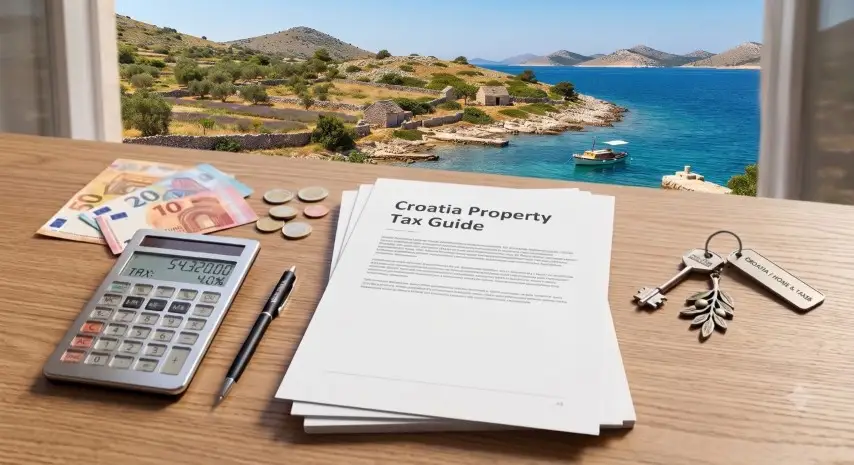
On the limestone-paved alleys above the cobalt Adriatic, Croatian property tax 2026 is not a single neat charge: it is a mix of transfer tax, local levies, notary fees, land registry checks and ownership admin that can shift your real buying budget before the keys are in your hand.
Miss that, and it bites.
I’m Luka, a coastal property advisor, and I’ve watched EU buyers fall in love with a sea-view balcony in the morning, then spend the afternoon asking sharper questions about property tax Croatia Adriatic coast rules, Croatia real estate tax for EU buyers, and uknjiba and katastar costs Croatia property at the notary’s desk.
Here, I’ll show you what to budget for, which offices matter, and why the quiet paperwork can be just as decisive as the view.
Sea views, sharp sums: Croatian property tax 2026 for Adriatic buyers
When to plan: 2026 tax timelines, purchase dates and office shifts
On the Adriatic coast, the tax clock starts sooner than many buyers expect. The view may sell the flat, but the dates decide the cash flow.
For most resale purchases in Croatia, the real estate transfer tax is generally 3% of the assessed market value, unless VAT applies instead, which is common with some new-build sales from developers. In practical terms, a €320,000 stone house above Vela Luka could bring a transfer tax bill of about €9,600, while a new apartment in Žnjan may have VAT treated differently inside the sales structure. Ask before you sign the pre-contract, not after the deposit has left your account.
The 2026 buying rhythm on the coast is seasonal. In Split, Dubrovnik, Šibenik and Zadar, offices slow down around public holidays, court desks can be thinner in August, and notaries near the Riva or old town streets often work around a rush of rental contracts, inheritance files and summer sales. It is not chaos. It is Croatia being Croatia.
| Stage | Usual timing | What to prepare |
| Before offer | 1 to 2 weeks | OIB, proof of funds, lawyer review, katastar and land registry check |
| Pre-contract | Same week to 10 days | Deposit terms, tax clause, seller ownership documents |
| Final contract | 2 to 6 weeks after checks | Notary appointment, certified translations if needed, payment trail |
| After signing | 30 days is a common tax filing window | Tax reporting, uknjižba filing, utility transfers |
If you are searching Croatian property tax 2026 from outside Croatia, plan one extra trip or give a narrow power of attorney to a trusted lawyer. Do not leave the OIB application until the morning of signing. The OIB is the personal identification number used by the tax office, bank, notary and many public bodies, and without it your purchase will drag its feet like a tourist in flip-flops on Marjan hill.
Local offices are also shifting more paperwork into digital systems, but that does not mean every case is cleanly handled online. Older houses in Primošten, Korčula, Vis and the back streets of Makarska often need paper files checked against scanned records. Build in time for that. A week can vanish quickly when the seller’s grandfather is still shown on one record and the renovated terrace is missing from another.
Where to buy on the Adriatic coast: zoning zones, permits and plot rules
Tax is only one part of the bill. The micro-location can change what you pay now, what you can build later, and whether the place will rent legally without stress.
The first line to check is zoning. Coastal property can sit inside a construction zone, an agricultural belt, a protected cultural zone, a maritime domain boundary, or a mix that makes everyone at the table suddenly very quiet. Around Rogoznica and Sevid, for example, buyers sometimes fall for plots advertised as “near the sea” before learning that access, building parameters or infrastructure are not what the brochure suggested. Near Dubrovnik’s Ploče and Lapad, heritage rules can affect windows, façades and internal works. In old Šibenik, near Gorica or Dolac, even a small renovation may need careful paperwork because the stone fabric is watched more closely.
Ask for the spatial plan extract, not just the agent’s cheerful map screenshot. The key questions are plain:
Is the plot inside the construction area? Agricultural land with olives may be lovely, but it is not automatically a villa plot.
What are the build parameters? Check permitted footprint, height, distance from boundaries and parking rules.
Is access registered? A pretty path used for 40 years is not the same as a recorded right of way.
Are utilities legal and adequate? Water cisterns, septic tanks and old electricity connections deserve a sober look.
Does the building match the permit? Extra rooms, closed terraces and rooftop additions can create trouble during uknjižba or resale.
This is where property tax Croatia Adriatic coast searches meet the real world. A seafront apartment in Bačvice may carry a different long-term cost profile from a hillside house in Brela or a rural OPG property above Pelješac. A working OPG can be attractive if you like olive oil, figs and actual soil under your shoes, but tax treatment, use rights and future rental plans need tailored advice.
Konoba culture also matters more than it sounds. A house next to a beloved village konoba in Ston may feel charming in March, then louder in August when tables spill outside and scooters line the lane. If you hope to run a small restoran or convert a ground-floor space for hospitality, zoning, sanitary approval, fire safety and neighbour relations all enter the picture. The Croatian property tax 2026 question then becomes only one line in a much bigger spreadsheet.
Do a weekday visit and a Saturday night visit. Walk the magistrala near the property, listen for traffic, check parking, smell the bins, and ask where the bora hits in winter. Glamour is useful. Drainage is better.
Where to get reliable answers: OIB, katastar, land registry and local experts
Your best answers come from records, not rumours. A charming neighbour may know every family story since 1962, but the katastar and land registry decide what you can prove.
Start with three public tracks: the tax authority, the cadastral office and the land registry court. In Split, buyers often deal with the local tax administration and the court land registry department at Općinski sud u Splitu, with many legal errands clustered around Gundulićeva and the centre. In Dubrovnik, files may pull you towards the court and administrative offices around Dr. Ante Starčevića. In Zadar, Šibenik and Makarska, the pattern is similar: tax, katastar, court, notary, then sometimes the municipal office for communal charges.
The names you will hear are:
Porezna uprava: the tax authority, relevant for transfer tax and other tax status questions.
Odjel za katastar nekretnina: the cadastral real estate department, used for parcel data, building footprints and cadastral plans.
Zemljišnoknjižni odjel: the land registry department of the municipal court, where ownership, mortgages and many legal burdens are recorded.
Javni bilježnik: the notary, who certifies signatures and handles formalities linked to contracts.
Lawyer and licensed surveyor: the people who can spot mismatches before they become expensive.
For Croatia real estate tax for EU buyers, the broad rule is friendly compared with many non-EU situations: EU citizens can usually buy under similar conditions to Croatian citizens, subject to the property type and any special restrictions. That does not remove the need for due diligence. It simply means nationality may not be the main obstacle.
Pay attention to document alignment. The land registry may show ownership, while the katastar may show the physical parcel and building record. When those two do not match, your lawyer needs to explain the gap in plain language. Sometimes it is a harmless legacy issue. Sometimes it is a warning siren wearing linen trousers.
Fees vary by property and workload, but you can budget sensibly. A lawyer might charge around 0.5% to 1% of the purchase price or agree a fixed fee for a simpler flat. Notary costs for signature certification can be modest, often tens of euros, while broader document work costs more. Certified translations, surveyor input and court fees can add several hundred euros, and awkward title clean-up can go higher. Ask for a written fee note before the work starts.
Compliance steps and admin side trips: uknjižba, notaries and municipal payments
Completion day feels final. Legally, it is more like the middle of the bridge.
After the purchase contract is signed and certified, your team should handle tax reporting, uknjižba and practical transfers. Uknjižba is the registration of ownership in the land registry. Without it, you may have paid for the property, but the public record has not caught up with reality. That gap can cause problems with resale, financing, inheritance and peace of mind.
A clean post-signing checklist looks like this:
Confirm the signed contract is properly certified by the notary and contains the correct parcel, building and owner details.
Submit or verify tax reporting with Porezna uprava within the required period, commonly treated as 30 days from the taxable event in standard cases.
File uknjižba with the land registry department and keep the filing receipt.
Check katastar updates if the building record, parcel shape or use description needs correction.
Transfer utilities for electricity, water, waste collection, building reserve payments and internet.
Ask the municipality about local charges, especially for holiday homes, rental use or communal fees.
The annual property tax position in 2026 can vary by municipality because local rates and categories matter. A second home in a coastal town may be treated differently from a main residence, a long-term rental or a property used for registered tourist letting. Some owners also pay tourist-related charges when they rent to guests. Do not rely on a friend’s bill from Omiš if you are buying in Hvar Town, because local decisions can move the numbers.
For uknjižba and katastar costs Croatia property buyers should expect small official fees in simple cases, then higher costs when lawyers, surveyors or corrections are needed. A straightforward flat in a newer building may involve limited filing costs. An old stone house in Korčula with an inherited courtyard, a konoba below and a terrace added during the 1980s can require survey work, extra statements and patient queueing.
There are also side trips nobody puts on the postcard. You may need to visit a municipal counter to ask about komunalna naknada, stop at the water company with the previous owner, or take a number at HEP for electricity. In Split, that can mean crossing town from the court area to an office off a busy road, then finding parking as the sun turns your dashboard into a toaster. Bring water. Bring copies. Bring a sense of humour.
The smartest move is to keep a single purchase folder, digital and paper. Store the OIB certificate, passport copy, purchase contract, tax decision, payment confirmations, land registry extract, katastar plan, energy certificate, utility transfers and rental approvals if relevant. When the next question arrives, and it will, you will not be digging through WhatsApp at midnight while your agent sends voice notes from a ferry.
Conclusion
Croatian property tax in 2026 is not there to spoil the sea view, but it will punish guesswork. I have seen buyers handle it well by treating the tax office, katastar, land registry and notary as part of the purchase route, not as dull stops after the exciting bit. The Adriatic rewards patience: check the title, price the transfer tax, confirm local charges, and leave room in the budget for the small fees that appear with old stone, shared courtyards and ambitious terraces.
If you are serious about buying on the coast, walk the lane, talk to the right offices, and get written advice before you sign. A clean file feels almost as good as a sunset over Korčula. Almost.
Questions & Answers
What is the main Croatian property tax in 2026 for buyers?
For many resale homes, the main buyer-side charge is real estate transfer tax, generally calculated at 3% of the assessed market value. New-builds sold with VAT can be treated differently, so you should confirm the tax position before signing the pre-contract.
Does property tax on the Croatia Adriatic coast vary by town?
It can. Local charges, holiday home rules, communal fees and tourist rental obligations may differ between places such as Split, Hvar, Šibenik or Makarska. A bill from one municipality is not a safe guide for another.
Can EU buyers purchase Croatian coastal property under the same tax rules?
EU buyers usually buy under broadly similar conditions to Croatian citizens, but the property type matters. Agricultural land, protected areas, unresolved title and commercial use can still create extra checks, costs or restrictions.
How much should I budget for uknjižba and katastar costs in Croatia property purchases?
It depends on the condition of the records. A clean apartment may only need modest filing fees and standard legal work, while an old stone house with mismatched katastar and land registry records may require a surveyor, lawyer time and additional corrections.
Do I need an OIB before paying property tax in Croatia?
You will need an OIB for the purchase process, tax administration, notary work and many utility transfers. Apply early, because waiting until completion week can delay signing and make a simple transaction feel unnecessarily tense.
📅 Last updated: