
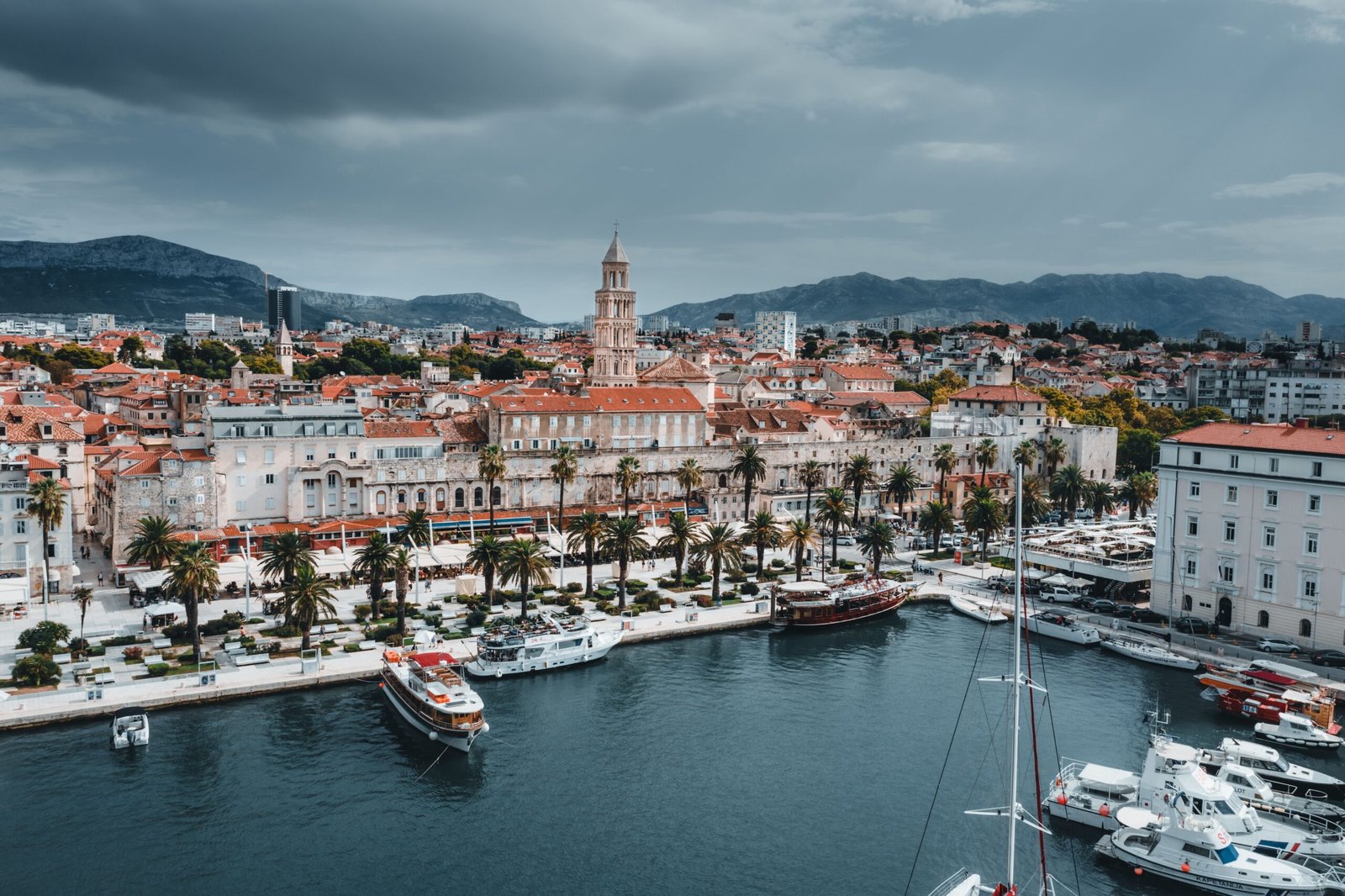
Split, Croatia: What to See, Where to Swim & How to Make the Most of It
Split is not just a transit point to the islands. It never was. Croatia’s second-largest city is a living, breathing Roman monument wrapped in a Mediterranean lifestyle — where locals hang laundry between ancient columns and fishermen sell their catch a few steps from a UNESCO-listed palace. Whether you’re planning a few days or an extended stay, Split rewards those who go beyond the cruise ship stops.
The old city is built inside Diocletian’s Palace — a 4th-century Roman emperor’s retirement complex that became, over centuries, an entire neighborhood. That fact alone tells you everything about Split’s character: layered, chaotic, and deeply alive.
Top Sights Inside and Around Diocletian’s Palace
The Palace itself covers nearly a third of Split’s old town. Walking through the Golden Gate (Zlatna vrata), you enter a maze of narrow lanes, basement halls, and sun-drenched squares. The Peristyle — the central courtyard — is where you’ll find locals having morning coffee next to tourists photographing centuries-old columns. That contrast is very much the point.
Don’t skip the Cathedral of Saint Domnius (Katedrala Svetog Duje), which was originally built as Diocletian’s mausoleum. Climbing the bell tower gives you the best elevated view of the old town rooftops and the Adriatic beyond. The ticket is cheap; the view is exceptional.
Below street level, the Palace Basements (Podrumi) are a well-preserved network of vaulted chambers mirroring the floor plan of the apartments above. They’re also where you’ll recognize the filming locations from Game of Thrones if that matters to you — and for many visitors, it does.
A short walk northwest along the waterfront promenade (Riva) brings you to the Meštrović Gallery, housed in the former studio and home of Croatia’s most celebrated sculptor. It’s one of the finest small museums in the entire Adriatic region.
Day Trips Within Easy Reach
Split’s location on the Dalmatian coast makes it a natural base. Ferries from the main port run frequently to Brač, Hvar, Šolta, and Vis. The fast catamaran to Hvar town takes under an hour. Trogir — a UNESCO-listed island-city connected to the mainland by bridge — is only 30 minutes west by bus along the coastal road (magistrala). Krka National Park is less than 90 minutes north by car or organized shuttle.
Best Beaches In and Near Split
Split’s beaches won’t give you the turquoise isolation of the outer islands. What they offer instead is convenience, character, and easy access from the city center.
- Bačvice – The most iconic urban beach in Croatia, just 10 minutes’ walk from the train station. Famous for picigin, a traditional shallow-water ball game played only in Split. Energetic, loud, and very local.
- Kaštelet (Firule) – A quieter pebble cove next to Bačvice, slightly less crowded and popular with families.
- Jezinac – Located below the Meštrović Gallery on the western peninsula of Marjan. Rocky entrance, crystal-clear water, shaded by pine trees.
- Kasjuni – A longer pebble beach on the southern slope of the Marjan hill. One of the most scenic urban beaches in Dalmatia, with a relaxed atmosphere even in peak season.
- Stobreč – A sandy beach in a small town immediately east of Split, accessible by local bus. Sand is rare along this coast — this one is worth the extra 15 minutes.
For serious beach days with clear water and fewer people, take the ferry to Šolta or the local boat to Čiovo island near Trogir. Both are within an hour of Split and dramatically quieter than the city beaches in July and August.
Practical Tips Before You Arrive
Split gets genuinely crowded from late June through August. If your schedule allows, May, early June, or September offer warm weather, lower accommodation prices, and significantly more breathing room in the old town.
Getting around is straightforward. The old town is entirely walkable. Local buses cover the wider city and nearby beaches. Ferries and catamarans depart from the main port adjacent to the Riva — buying tickets in advance online during summer is strongly recommended, especially for Hvar.
Accommodation inside the Palace walls offers atmosphere but expect noise until late at night. Streets in Varoš (the old neighborhood just west of the Palace) and along Meje peninsula tend to be quieter and still central.
Tap water in Split is safe and good quality. The local markets (pazar) outside the Golden Gate sell fresh produce, local cheese, and Dalmatian prošek wine — far better value than the tourist restaurants on the Peristyle. A tourist tax (boravišna pristojba) is automatically added to most accommodations — typically 1–2 EUR per person per night depending on the category.
Frequently Asked Questions
How many days do you need in Split?
Two full days are enough to cover the essential sights inside the Palace and walk the Marjan peninsula. Three days gives you time for a day trip to Hvar or Trogir without feeling rushed. If you’re using Split as a base to explore the islands, a week is comfortable.
Is Split safe for tourists?
Split is generally very safe. Petty theft in crowded areas — particularly around the Riva and ferry port in summer — is the main concern. Keep your belongings secure in busy spaces, and you’re unlikely to have any problems. The city has a visible police presence throughout the tourist season.
What is the best way to get to Split from Dubrovnik or Zagreb?
From Dubrovnik, the most scenic option is the coastal catamaran operated seasonally — it stops at several islands and takes around 4–5 hours. Buses are frequent and take about 4 hours by road. From Zagreb, buses and trains both connect to Split, with travel times of 5–6 hours depending on the route. Split Airport (Zračna luka Split) in Kaštela also handles direct international flights throughout the year.